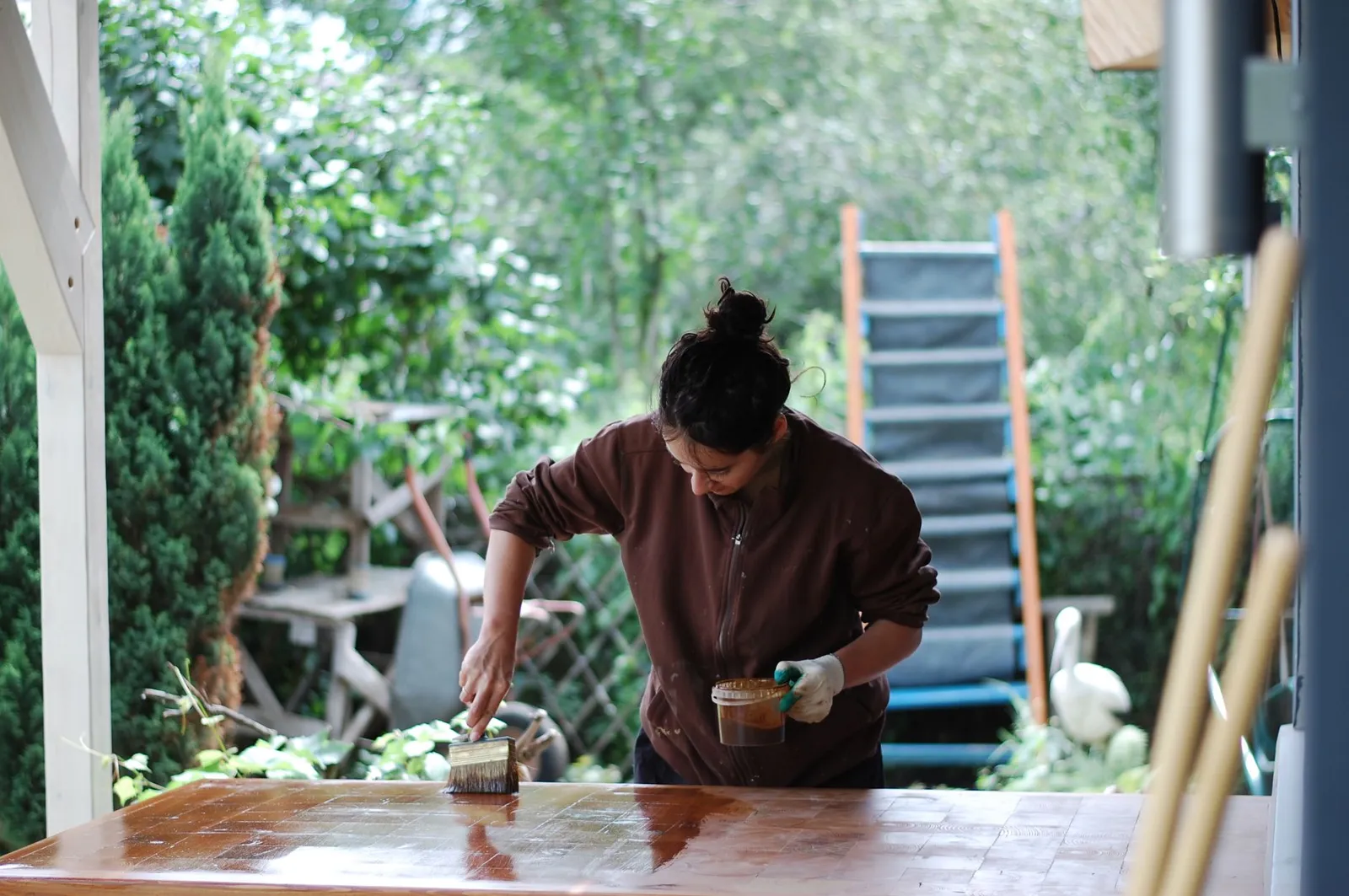
"Can you French polish it?" is one of the most common questions we get, and the honest answer is usually: it depends what you want the piece to do. French polishing is a beautiful finish and a practical one, but it is not a protective coating in the way a modern lacquer is. Understanding the difference prevents a lot of disappointment on a dining table.
What French polishing actually is
Shellac is a resin secreted by the lac insect, sold as dry flakes and dissolved in denatured alcohol. A French polish is built up by hand in many thin layers, applied with a pad wrapped in cloth — a rubber — worked in overlapping circles and long strokes. The alcohol softens the previous layer slightly, and the shellac flows into the grain. The result is a thin, clear film with a warm colour and a depth that looks like the timber itself rather than a coating sitting on top.
It is labour-intensive and slow. A dining table might take several sessions over a week, with drying and cutting back between them. The final surface can be left with a high gloss, a satin sheen or a flatter, more contemporary look. It can also be applied over an existing shellac finish that is sound, which is often better than stripping a piece back to bare wood.
Where shellac is the right choice
For antique and period furniture — mahogany, walnut, rosewood, older oak — shellac is often the most sympathetic finish. It can be matched to the colour and sheen of an existing surface, it sits well over old patina, and it is repairable. A scuff or a bloom can often be re-amalgamated locally without refinishing the whole top. That matters when the alternative is losing a century of colour.
It is a good fit for bedroom furniture, side tables, cabinets, picture frames and pieces that are looked at and handled gently. It is also the right choice when the goal is conservation rather than daily toughness.
Where we would not use it
A shellac film is thin and alcohol-soluble. A spilled gin and tonic, a hot mug, a wet glass left overnight or a child's felt-tip pen can all leave a mark that a lacquer or oil finish would shrug off. On a dining table used every day, especially in a humid flat with frequent air-conditioning, we usually recommend a hardwax oil or a moderately sheened lacquer instead. Both are more forgiving and easier for a household to maintain.
We would also avoid shellac in kitchens, bathrooms and anywhere the piece will sit in direct sun or against a damp wall. And we would not apply it over a surface that has been contaminated with silicone polish; the new finish will not adhere properly. That is one of the reasons we ask what a piece has been cleaned with.
None of this makes shellac a "bad" finish. It makes it a specific one. The mistake is choosing it for its appearance in the workshop and then expecting it to behave like a factory tabletop at home.
Living with a French-polished surface
Use coasters and mats, wipe spills immediately with a dry cloth, and avoid alcohol-based cleaners. A coat of good furniture wax once or twice a year is enough; more is not better, because wax builds up and dulls the surface. Keep the piece out of direct sun and away from air-conditioning vents, for the reasons in our note on humidity.
If a white ring appears, do not sand it. Shellac can often be re-amalgamated by someone who knows the finish. If the ring is dark or the finish has lifted, it needs to be looked at properly. A French polish can be revived many times over its life; that is one of its virtues.
How we choose a finish
We keep sample boards in the finishing room, covering different timbers, sheens and products. Before any top is finished, we prepare a patch on an offcut or a hidden area, show it to you under the light of the room it will live in, and explain the maintenance it will need. The right finish is the one that suits the piece, the room and the person using it — not the one that looks best in a photograph.
Our finishing service covers French polishing, hardwax oil and lacquer, and we are happy to talk through the trade-offs before you commit.